

Have you ever wondered why someone can have thick-looking hair while another person with a similar curl pattern appears to have much fuller hair?
The answer may lie in two important characteristics: hair density and hair thickness.
Although these terms are often used interchangeably, they describe different things. Understanding the difference can help you make more informed decisions about your hair care routine.
What Is Hair Density?
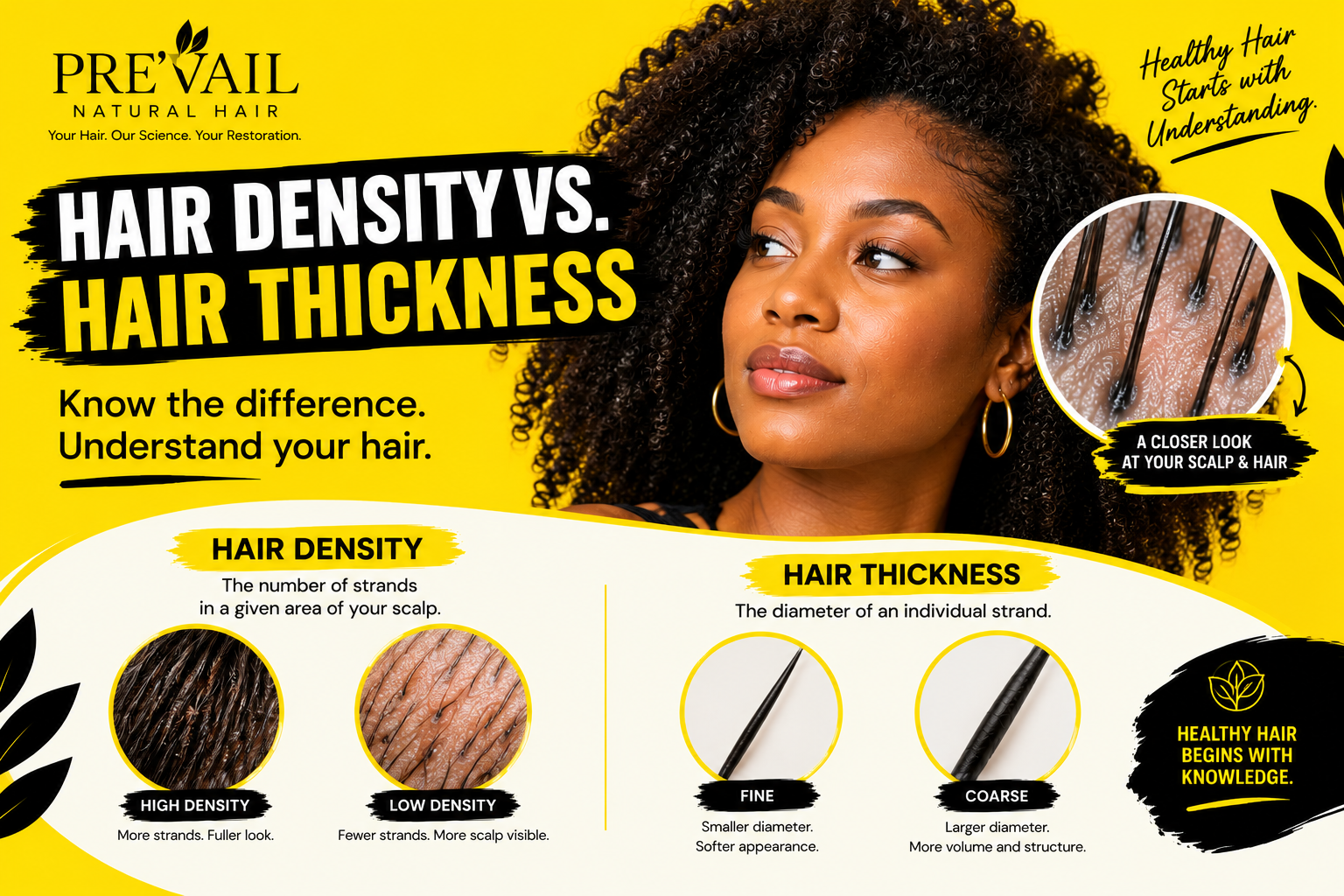
Hair density refers to the number of individual hair strands growing within a specific area of your scalp.
High-density hair has more strands growing within an area, while low-density hair has fewer. Density affects how full your hair looks and how much of your scalp is visible.
If your scalp is becoming more noticeable around your part or temples, changes in density may be worth investigating.
What Is Hair Thickness?
Hair thickness refers to the diameter of an individual strand.
Some people naturally have fine strands, while others have medium or coarse strands. This is different from having a lot of hair.
For example, you can have many fine strands and therefore high-density hair. You can also have fewer coarse strands and lower-density hair.
Density describes how much hair you have. Thickness describes how wide each strand is.
Why Does the Difference Matter?
Understanding these characteristics can help you choose hair care practices that better suit your needs.
Fine strands may be more vulnerable to certain types of damage, while low-density hair may benefit from styling techniques that create the appearance of fullness.
More importantly, a noticeable change in your usual density or strand thickness may deserve closer attention, particularly if accompanied by excessive shedding, breakage, or a widening part.
Genetics, aging, hormonal changes, certain health conditions, and hair damage can all influence the appearance and condition of your hair.
Look Beyond What You See
Your hair's appearance tells only part of the story.
At Pre’Vail Natural Hair, professional hair and scalp analysis can help assess visible characteristics such as strand diameter, scalp condition, and patterns of density. These observations can provide useful information when deciding whether further evaluation is needed.
The goal is to understand your hair rather than rely on assumptions or keep trying products that may not address your concerns.
Understand Your Hair. Care for It Better.
Whether your hair is naturally fine, coarse, high-density, or low-density, the key is understanding what makes it unique—and recognizing when something changes.
If you've noticed a difference in your hair's fullness or strand thickness, consider taking a closer look.
Pre’Vail Natural Hair — Your Hair. Our Science. Your Restoration.
📞 (432) 210-4850
🌐 www.prevailyournatural.com
📍 1151 Hammond Dr, Ste 200, Dunwoody, GA
